



|
The Cure For "Hurry Sickness" Has Many Beneficial Side Effects
Many years ago, amidst the sometimes chaotic lifestyle of a surgeon, I was introduced to Greg Schweitzer. His calm almost serene demeanor made me like him instantly. The purpose of our meeting was not happenstance, but instead to afford me the opportunity to experience an age old tool -- meditation.
My workday world had become so full, I found I wanted something to relieve the constant pressures of dealing with the sick and dying. I had an ulterior agenda as well, for I was very much aware that something was missing in my practice of surgery, that was more was necessary to complete the healing paradigm, and that mainstream medicine, while paying lip service to "alternative" methods of healing, just wasn't serving up practical solutions.
I had just read a modern day philosopher, Christopher Losch, who addressed the issue of stress. In a wonderful essay he spoke of each generation in this country being afflicted with its own particular form of pathology. Ours, he states was "hurry sickness". I could not agree more, and felt like I was thoroughly afflicted!
In my search, I discovered Schweitzer. Gregg, a 1971 graduate of Drexel University in industrial engineering was by trade the last person you would expect to be teaching a course on stress reduction and mindfulness.
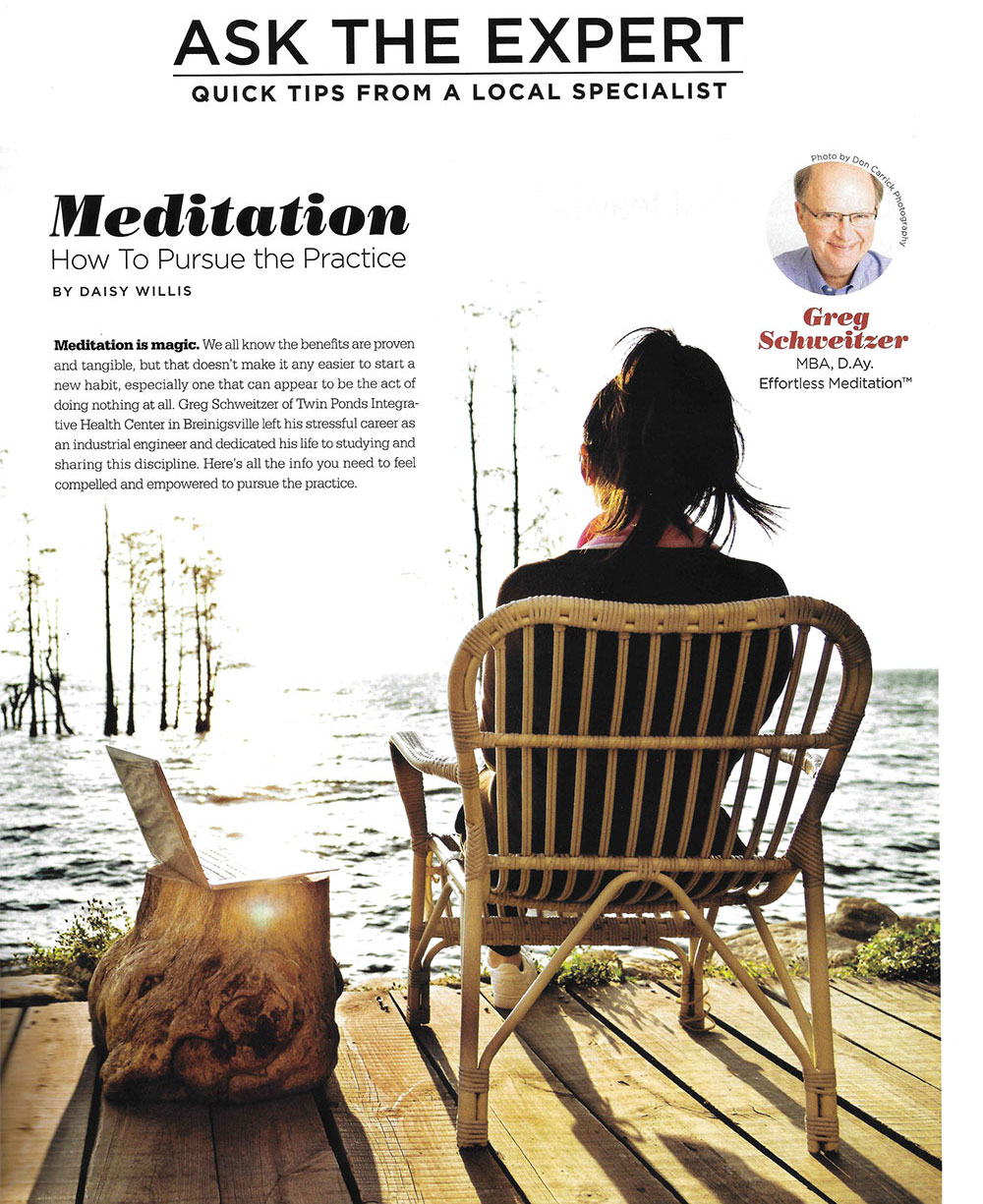
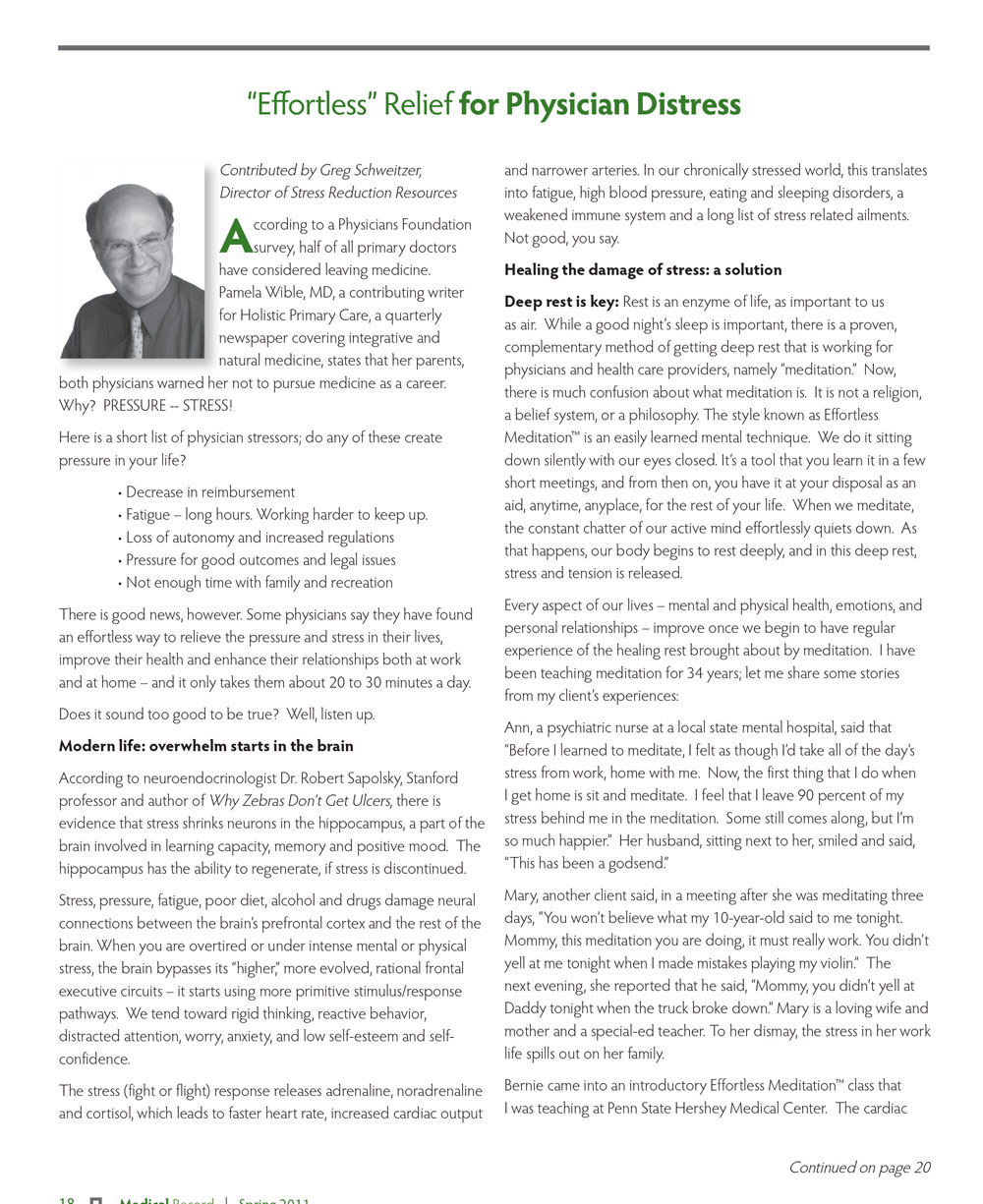
Greg taught me meditation, an opportunity to spend 10 to 20 minutes twice a day with myself in an effort to regain my balance, turn down the constant flow of cortisol and other stress hormones from my adrenal glands and learn to "chill." For the most part it helps immensely. My blood pressure, which had become mildly elevated, returned to normal, and I found I could better cope with my daily routine. This is a tool I can utilize for life.
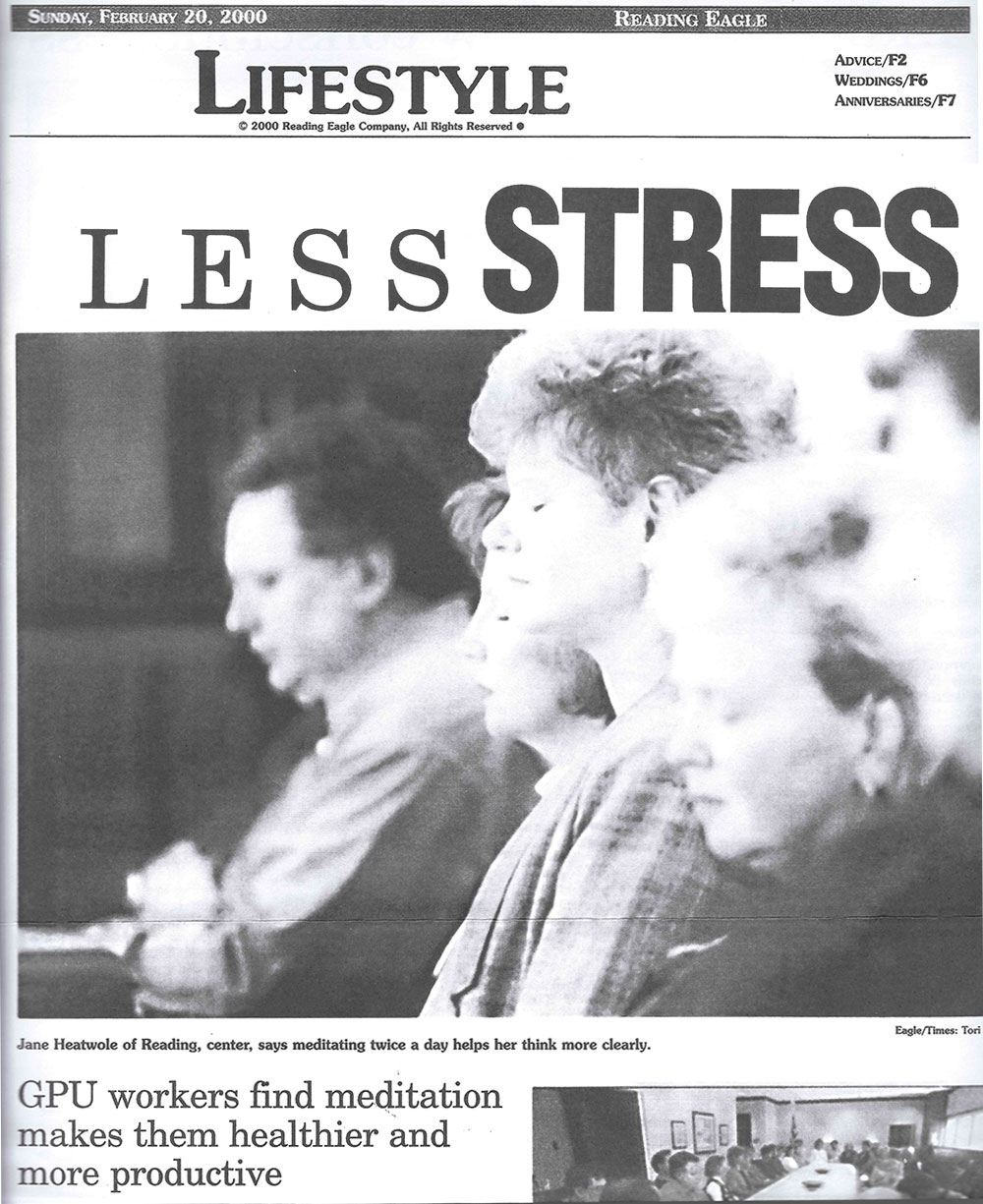
Schweitzer, with his wife Karen, runs Stress Reduction Rresources, a consultative and educational source that, in their words, attempts to "restore balance in today's changing environments." The Sinking Spring enterprise has recently been employed by GPU and Air Products executives and other employers to help facilitate healthier and more productive workers.
"The conscious mind is bombarded, like stormy waves on an ocean surface, by the strains of modern change. Everything suffers. The immune system is depressed, which opens up the individual to hypertension and other well-known stress related ailments," Schweitzer states. This physician concurs. "And it is deeper, below the surface of the storm that often the water is much calmer. It is a personal retreat and it is there that meditation endeavors take its practitioners."
Like most renaissance individuals, Schweitzer found his way to his career by a circuitous path. While going through a rough time in the early 70s, he heard messages delivered by Dr. Deepak Chopra and other notables. Greg has over 5000 hours now as an instructor in what he calls "effortless" meditation that he at first blended with an engineering and sales career. Now it's his passion, and this is the way he has chosen to make a difference.
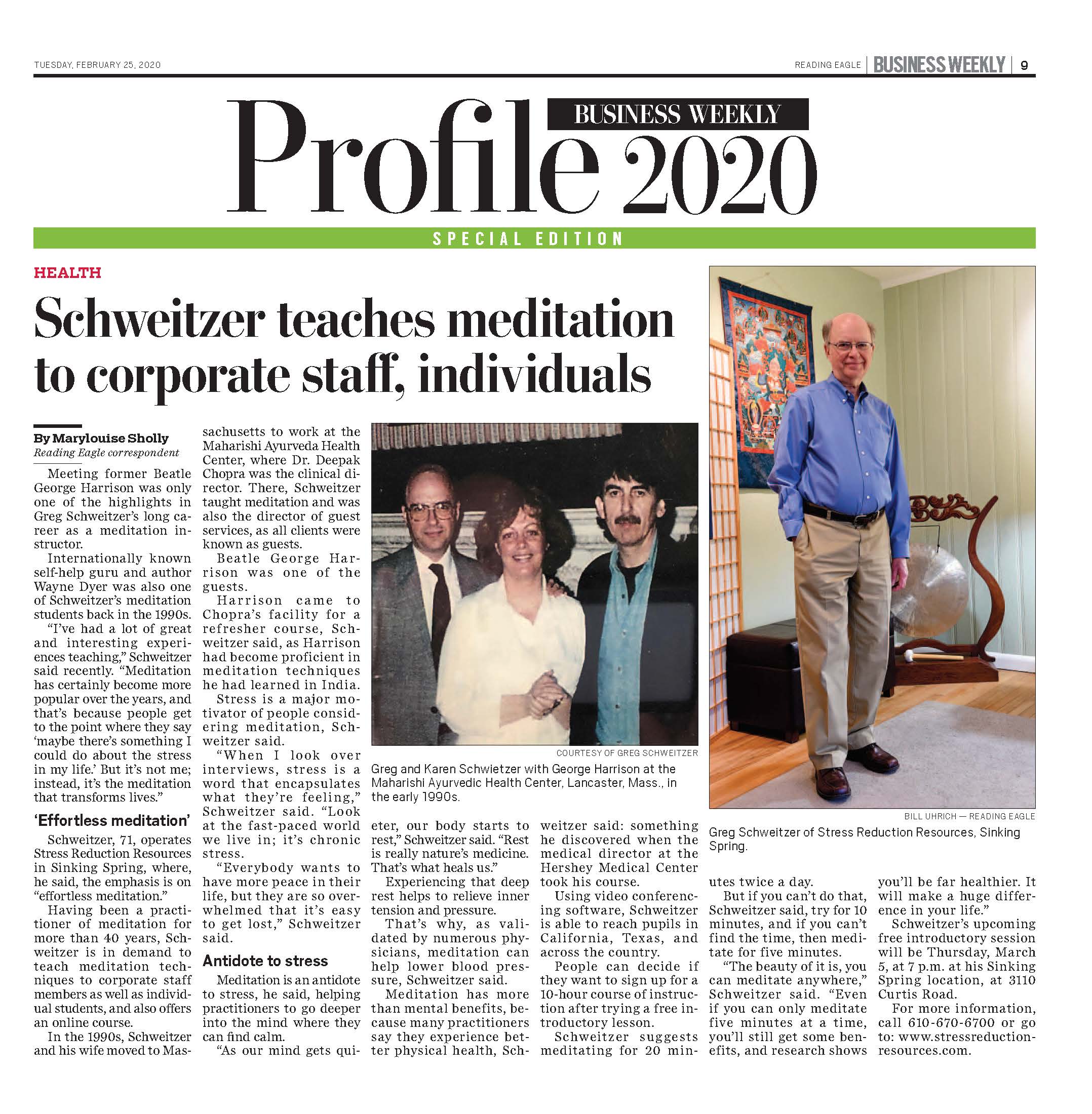
In his travels as an instructor, practitioner and a lecturer he has taught such entertainers as Barbra Streisand and George Harrison. In no way has Schweitzer or his wife disavowed mainstream health care. This is an opportunity to blend, to integrate what is out there to help people. We offer Reikii therapy, massage, and yoga as well as meditation to help deal with modern stresses," says Greg. "More and more corporations are finding us. I have even taught the technique to the Director of medicine at Hershey medical center, Mike Weitekamp, M.D. He too recognized that there had to be more than the 'medical reductionism' he was taught. He chose to learn and practice meditation."
Many physicians know that treating people is often dictated by time constraints. It is much easier to diagnose someone with a pill. We have a bottle of drugs for anxiety, sleep, and depression. But this doctor and many others always have felt there has to be a better way. I'm convinced that for anyone who would take the effort, a clearer sense of self and health would emerge with this practice.
"Chopra speaks of health as being at the center of ourselves. One very excellent way through the confusion, tumult and chaos to the calmer waters of who we are is through meditating." Be aware that meditation speaks to no religious practices -- this is a great and very erroneous misconception. It is a technique that allows us to get to know the person we spend 99.9% of our lives with, yet never seem to get to know -- ourselves.
In our efforts to live longer calmer, fuller and more productive lives, the battle for "who's in charge" rages on. We often surrender to the changes that rule us. We know intuitively that this kind of behavior makes for poor health, shorter lives and often less than fulfilling relationships.
"Like an archer ready to aim his bow and arrow at a target we must prepare ourselves to meet our goals. But the first step is to pull the arrow back on the string, in the opposite direction of the bull's-eye. At the maximum point, just before release, the entire effort is still and quiet nothing happens until the string is let go. Meditation is like that. A stillness, a deep rest, a place where nothing happens but the experience of self." To go within says one master can be the scariest of places. But real heroes, people who experienced their personhood and find out who they are, stay well and happy longer. "And," Schweitzer is quick to add, "know who everyone else is. They feel a real bond with humanity that makes life a happy experience."
|