


http://www.stressreductionresources.com

Effortless Relief for Physician Distress
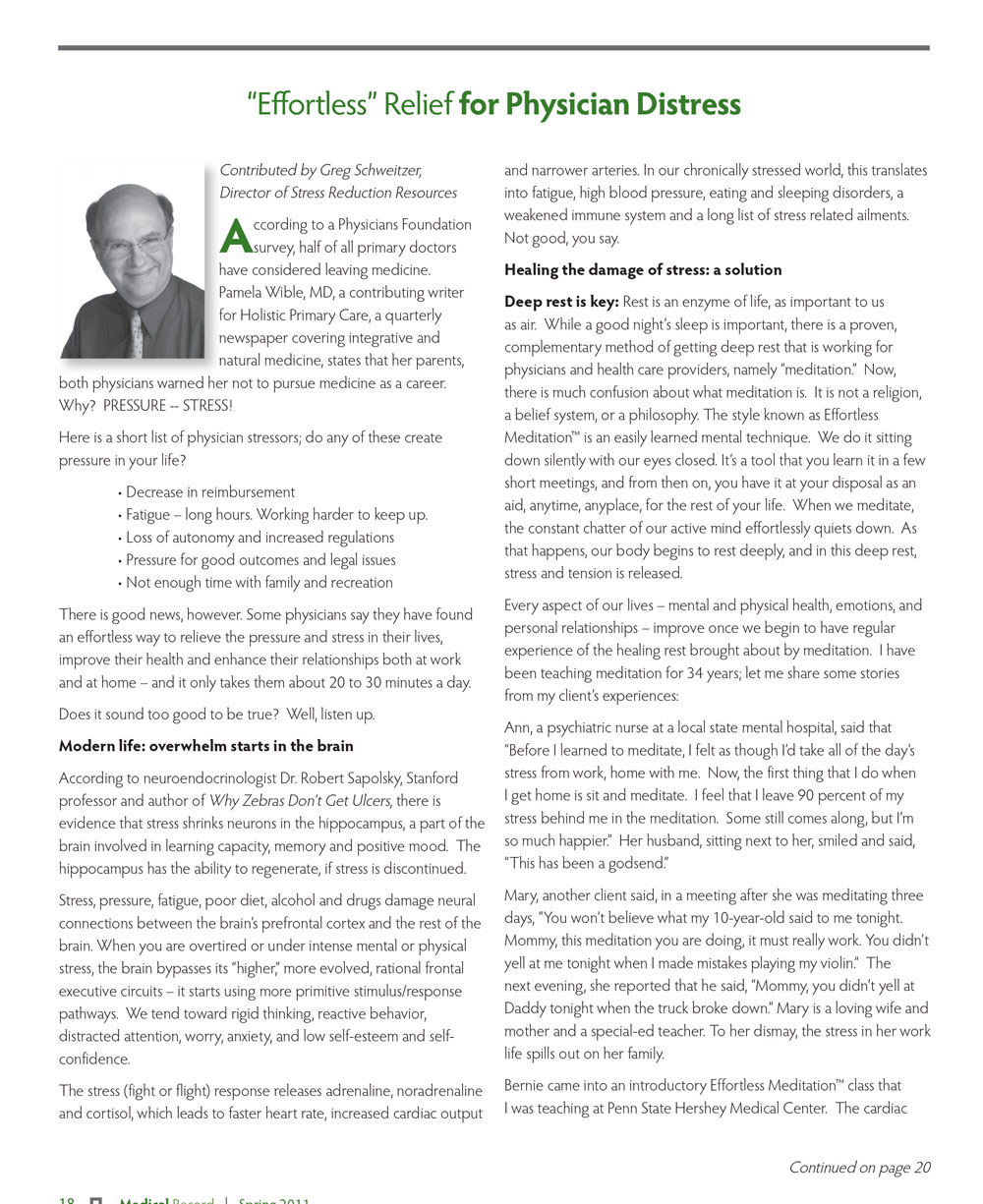
by Greg Schweitzer


This article appeared in The Berks County Medical Record and is reprinted courtesy of its publisher, Berks County Medical Society.

According to a Physicians Foundation survey, half of all primary doctors have considered leaving medicine. Pamela Wible, MD, a contributing writer for Holistic Primary Care, a quarterly newspaper covering integrative and natural medicine, states that her parents, both physicians warned her not to pursue medicine as a career. Why? PRESSURE -- STRESS!

Here is a short list of physician stressors; do any of these create pressure in your life?

  • Decrease in reimbursement

  • Fatigue - long hours. Working harder to keep up.

  • Loss of autonomy and increased regulations

  • Pressure for good outcomes and legal issues

  • Not enough time with family and recreation

There is good news, however. Some physicians say they have found an effortless way to relieve the pressure and stress in their lives, improve their health and enhance their relationships both at work and at home - and it only takes them about 20 to 30 minutes a day.Does it sound too good to be true? Well, listen up.

Modern life: overwhelm starts in the brain

According to neuroendocrinologist Dr. Robert Sapolsky, Stanford professor and author of Why Zebras Don't Get Ulcers, there is evidence that stress shrinks neurons in the hippocampus, a part of the brain involved in learning capacity, memory and positive mood. The hippocampus has the ability to regenerate, if stress is discontinued.

Stress, pressure, fatigue, poor diet, alcohol and drugs damage neural connections between the brain's prefrontal cortex and the rest of the brain. When you are overtired or under intense mental or physical stress, the brain bypasses its "higher," more evolved, rational frontal executive circuits - it starts using more primitive stimulus/response pathways. We tend toward rigid thinking, reactive behavior, distracted attention, worry, anxiety, and low self-esteem and self-confidence.

The stress (fight or flight) response releases adrenaline, noradrenaline and cortisol, which leads to faster heart rate, increased cardiac output and narrower arteries. In our chronically stressed world, this translates into fatigue, high blood pressure, eating and sleeping disorders, a weakened immune system and a long list of stress related ailments. Not good, you say.

Healing the damage of stress: a solution

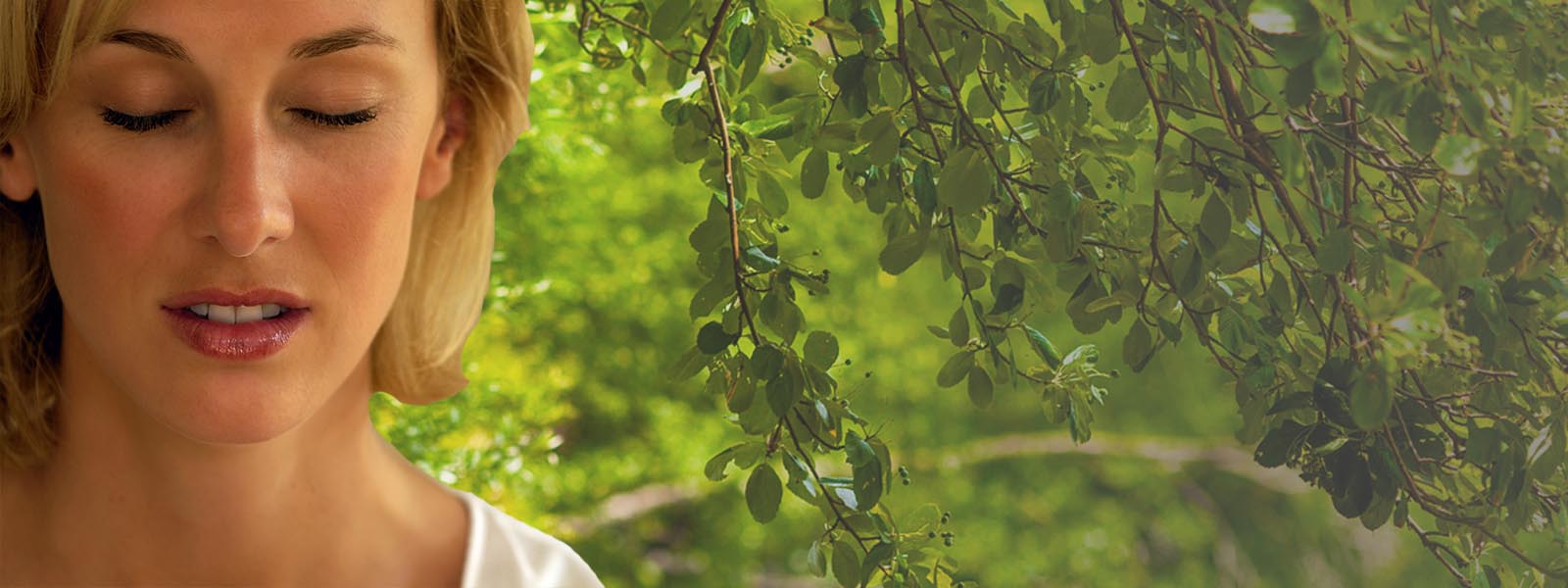
Deep rest is key: Rest is an enzyme of life, as important to us as air. While a good night's sleep is important, there is a proven, complementary method of getting deep rest that is working for physicians and health care providers, namely "meditation." Now, there is much confusion about what meditation is. It is not a religion, a belief system, or a philosophy. The style known as Effortless Meditation™ is an easily learned mental technique. We do it sitting down silently with our eyes closed. It's a tool that you learn it in a few short meetings, and from then on, you have it at your disposal as an aid, anytime, anyplace, for the rest of your life. When we meditate, the constant chatter of our active mind effortlessly quiets down. As that happens, our body begins to rest deeply, and in this deep rest, stress and tension is released.

Every aspect of our lives - mental and physical health, emotions, and personal relationships - improve once we begin to have regular experience of the healing rest brought about by meditation. I have been teaching meditation for 34 years; let me share some stories from my client's experiences:

Ann, a psychiatric nurse at a local state mental hospital, said that "Before I learned to meditate, I felt as though I'd take all of the day's stress from work, home with me. Now, the first thing that I do when I get home is sit and meditate. I feel that I leave 90 percent of my stress behind me in the meditation. Some still comes along, but I'm so much happier." Her husband, sitting next to her, smiled and said, "This has been a godsend."

Mary, another client said, in a meeting after she was meditating three days, "You won't believe what my 10-year-old said to me tonight. Mommy, this meditation you are doing, it must really work. You didn't yell at me tonight when I made mistakes playing my violin." The next evening, she reported that he said, "Mommy, you didn't yell at Daddy tonight when the truck broke down." Mary is a loving wife and mother and a special-ed teacher. To her dismay, the stress in her work life spills out on her family.

Bernie came into an introductory Effortless Meditation™ class that I was teaching at Penn State Hershey Medical Center. The cardiac rehab staff there referred him to the class because his resting blood pressure averaged 190/90 and they were unable to help him. Bernie was looking for relief and was hopeful this would help, so he enrolled in the course. After doing his 15-20 minute meditation practice for three days, he reported that he couldn't believe how good he felt. Encouraged, he continued to meditate daily, and when he came in for a three month check-up, he declared that his blood pressure was down to 138/78. His doctor was astounded. Over the next 1.5 years, his physician weaned him off all blood pressure medication.

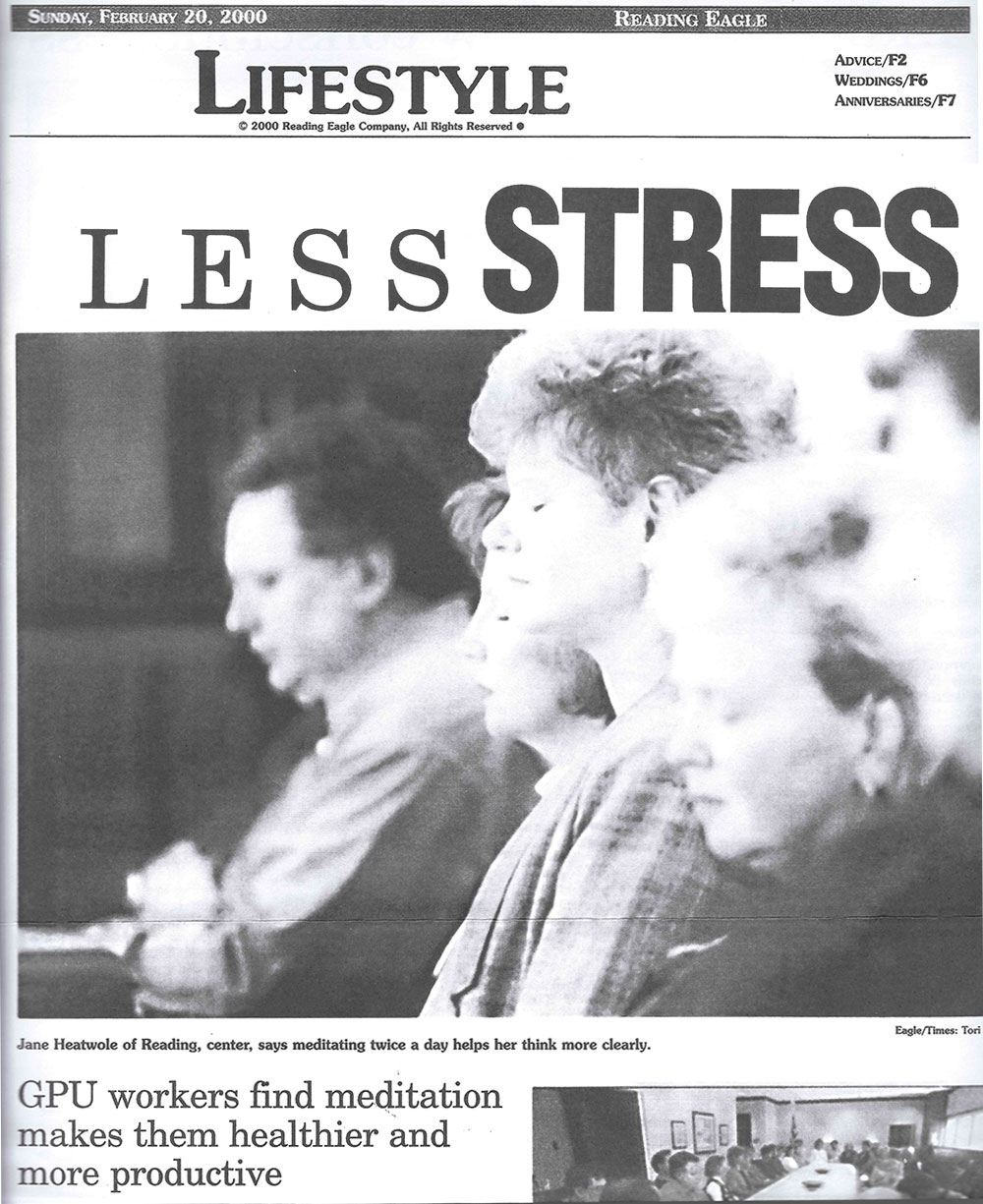
Jeff, a director at a local utility company, decided that Effortless Meditation courses would be ideal for stress reduction in the workplace. The results from the classes were so gratifying that what started as a trial initiative of 12 employees turned into a training program where over 150 people chose to participate. In a Reading Eagle article reporting on this extraordinary project, employees expressed that after meditation they were more productive, less stressed and tense, thinking more clearly and enjoying their work and family more.

Summary

Stress is a natural part of life; however, for many, our modern lifestyles are filled with chronic stress, pressure and fatigue, all of which ravage our physical and mental health. There is a huge body of scientific research and personal experience indicating that we can significantly and effortlessly improve the way we respond to the debilitating effects of chronic stress. Meditation is a tool to do just that. Influential leaders such as Drs. Deepak Chopra, Mehmet Oz, Andrew Weil and Herbert Benson have been recommending it for years. It is bringing a rhythm of healing rest into the overly busy lives of physicians, health care workers and their families. It is easy to learn, effortless to do and can be done almost anywhere, anytime.

For further information, contact Greg Schweitzer. He is the Sinking Spring, PA, based director of Stress Reduction Resources.

� 2006-2011 StressReductionResources.com All Rights Reserved. Reproduction without permission prohibited.